
Fresno County City Directory Collections
The strongest Fresno County city directory shelf is at the Genealogy & Local History Library. Countywide directories exist for most years, while publisher geography shifts over time. Polk-Husted, later R.L. Polk, began its familiar Fresno run in 1907 and covered all or most of the county through 1957. After that, the run became Fresno city only, with Clovis returning in 1973. Haines Criss-Cross restored a countywide address route in 1973.
| Collection | Years or Coverage | Where Held | Access |
|---|---|---|---|
| Polk-Husted and R.L. Polk directories | 1907 onward; countywide through 1957, then Fresno city, Clovis again in 1973 | Genealogy & Local History Library | Microfilm and later hardcopy |
| County and city directories | Most years, with named gaps | Library local-history collection | Onsite research; materials do not circulate |
| Haines Criss-Cross | Countywide from 1973 | Same specialist library | Address and telephone sequence, onsite |
| Telephone directories | 1909 onward, with changing regional footprints | Library collection | Historical volumes, onsite |
| Digital discovery partners | Collection-specific | FamilySearch, AncestryLE, Calisphere, OAC, California Revealed | Some require library or affiliate access |
Use the Fresno directory collections page for the current list and then ask for the exact year. A directory title alone is not enough when a countywide volume becomes city-only.
Fresno County's Directory Shelf
The specialist library reports about 30,000 books and pamphlets, 5,000 microforms, and 300 CD-ROMs across its local-history and genealogy holdings. Directory users can also consult newspapers, yearbooks, maps, vertical files, oral histories, Fresno County records, and in-library Ancestry Library Edition. The facility is at 5769 N. First Street in Fresno. Reported hours are Tuesday, Thursday, and Friday 10-5, Wednesday noon-7, and Saturday 10-2. Materials do not circulate, so bring a pencil or camera plan and record the collection title before turning pages.
One-on-one genealogy help is available. Email research may require at least one working week. A useful request names the person, spelling variants, town, possible address, date range, and collection already checked. FamilySearch affiliate access may unlock restricted digital images onsite. Fresno State Special Collections and University Archives, the Online Archive of California, Calisphere, California Revealed, and the California Digital Newspaper Collection provide additional discovery routes.
The library's directory overview is at the Fresno Directory Collections page.
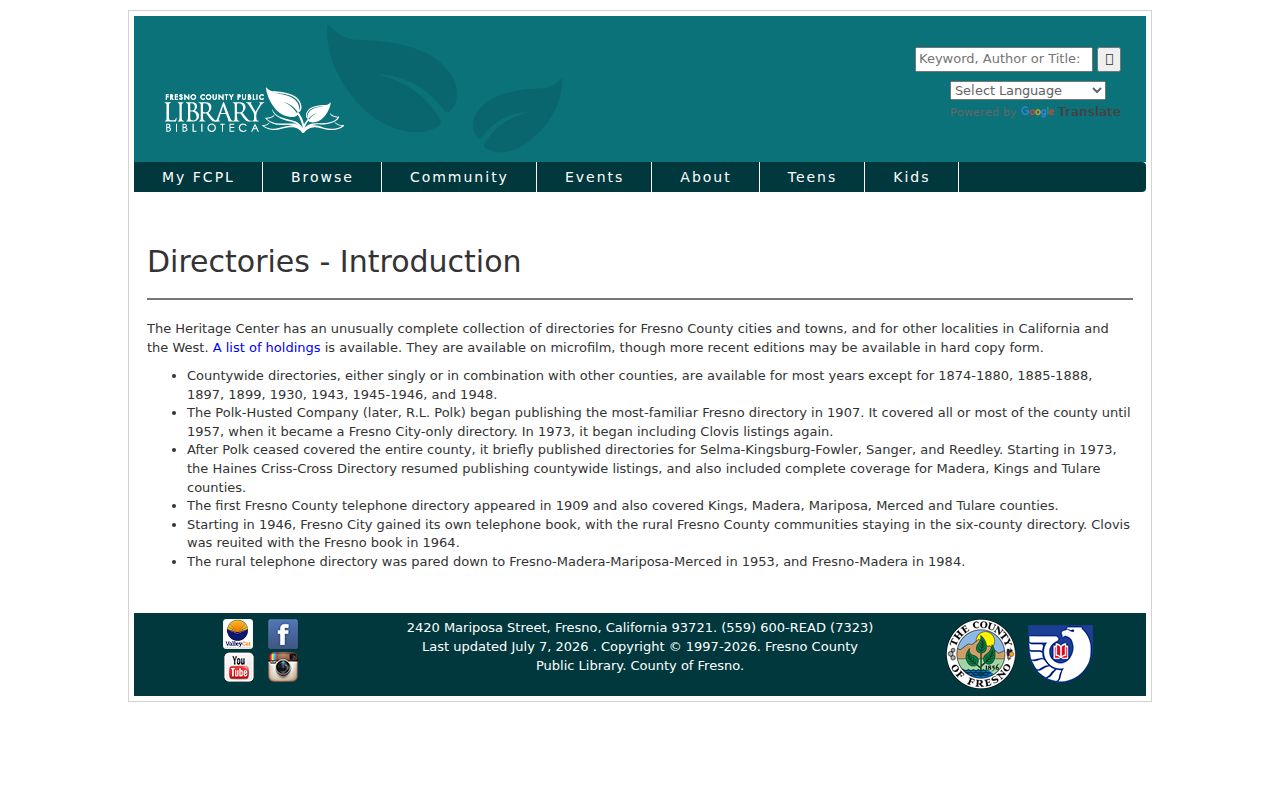
The directory-collection capture points to the shelf where publisher years and gaps can be checked directly.
Fresno County Directory Gaps
Countywide directories have stated gaps in 1874-1880, 1885-1888, 1897, 1899, 1930, 1943, 1945-1946, and 1948. A missing volume should not be turned into a missing person. Publication may have paused, a title may be filed in another run, or a countywide footprint may have narrowed to a city. Check the catalog, the next available year, newspapers, and the telephone series before closing a search.
Telephone geography adds another layer. The first Fresno County telephone book appeared in 1909 and also served surrounding counties. Fresno City received its own telephone book in 1946. Rural communities remained in a six-county book before coverage narrowed to Fresno, Madera, Mariposa, and Merced in 1953, then Fresno and Madera in 1984. Clovis joined the Fresno book in 1964.
For a historical household, record “not found” with the exact publisher, year, geographic scope, and page sequence. That note makes a gap useful evidence rather than a false absence.
Fresno County Polk Geography Changed
The 1957 Polk change is a key Fresno County publication quirk. Before that point, the familiar Polk-Husted or R.L. Polk series covered all or most of the county. Afterward, the main run focused on Fresno city. Clovis returned in 1973, the same period in which Haines Criss-Cross restored a countywide address-oriented route. A researcher comparing a rural town, Clovis, and central Fresno must choose a volume whose coverage matches the address.
California State Archives materials can help place a local directory beside broader county and state records. The archive catalog is a discovery tool, not a promise that a particular page is digitized or immediately available. Ask for the series, county, date, and access conditions.
See the California State Archives catalog before assuming a state-held item replaces the library shelf.
The archive image belongs beside, not above, the local library record. Each custodian may hold a different part of a historical trail.
Reading Fresno County City Directory Entries
A Fresno County city directory entry is a compact clue set. Transcribe the line exactly, then expand the volume's abbreviation key. A common Polk-style entry can include surname, given name or initial, spouse in parentheses, widow notation, occupation, listed business, residential address, and sometimes a homeownership marker. Business entries can list officers and a business address. The official collection description does not reproduce a legible named sample page, so exact symbols should be checked onsite before quotation.
| Name | Surname and given name or initial; a spouse may appear in parentheses. |
|---|---|
| Family clue | Spouse or “wid” notation can connect a household across years. |
| Occupation | Trade or role, sometimes with an employer or business. |
| Address | House number and street, with publisher-specific abbreviations. |
| Owner mark | Some runs mark a homeowner; copy the symbol and key rather than guessing. |
- Criss-cross directory
- An address-order section or volume that lets a search begin with a street and number.
- Householder index
- An alphabetical route to the person or head of household named by the publisher.
- Abbreviation key
- The volume's legend for occupation, relationship, address, and status marks; photograph or transcribe it first.
Fresno County Telephone Book Boundaries
A telephone book is not the same as a printed resident directory, even when the two sit next to each other. Telephone coverage followed exchange and rural service geography. The 1909 Fresno County book reached Kings, Madera, Mariposa, Merced, and Tulare as well. Fresno City gained its own book in 1946, while Clovis joined the Fresno book in 1964. The rural footprint changed again in 1953 and 1984.
Use a telephone volume to corroborate a listed subscriber and address, not to infer a complete population. Unlisted numbers, delayed moves, rural exclusions, and publication timing all create gaps. Pair the phone entry with a Polk name entry, deed, census schedule, newspaper, or obituary where the question calls for a household history.
When a street seems absent, search the neighboring exchange or regional volume before changing the spelling. The publisher's map is part of the evidence.
Using Fresno County Directories for Family History
A directory year can anchor a person between federal census dates. Begin with the first known name and place, then follow the entry forward and backward while recording address, spouse, occupation, and any directory mark. Pair 1880 and 1900-1950 census schedules with the closest directory years. The 1890 population schedules were largely lost nationally, so a directory, newspaper, deed, or vital index may fill that interval.
- Choose a starting year. Use a known address or age clue and select a directory whose geography includes that place.
- Read the alphabetical entry. Copy the name, spouse, occupation, address, and abbreviation marks.
- Flip to address order. Use Haines or a criss-cross section to see whether the address and nearby numbers persist.
- Pair the next census. Compare household members, age, occupation, and place rather than relying on a surname alone.
- Close the event. Check obituary, cemetery, vital, probate, or later deed sources for a move, death, or heir connection.
Disappearing from a volume can mean a move, death, no listing, a publication gap, a changed boundary, or a different surname form. A second source decides which explanation is plausible.
Fresno County Maps and House History
Maps let a directory entry stay attached to a place when the street name or parcel form changes. The library's heritage maps page links local atlases, Sanborn maps, property atlases, and aerial resources. Fresno State MALT indexes regional flights from 1937-1999. A 1939 Fresno city block-book set noted by the Historical Landmarks & Records Commission may bridge older lots to modern APNs. For a current address layer, compare the City GIS data with county parcel maps.
Historic Homes resources add a Fresno Historic Residence Research Guide, preservation references, and county landmark leads. The map or guide does not replace title evidence. It tells the researcher which lot, street, building footprint, or name deserves a closer deed, permit, or directory check.
Start with the library's Heritage Maps collection. If the question concerns a municipal file rather than a historical volume, the Fresno City Clerk public-records request page explains the city route.
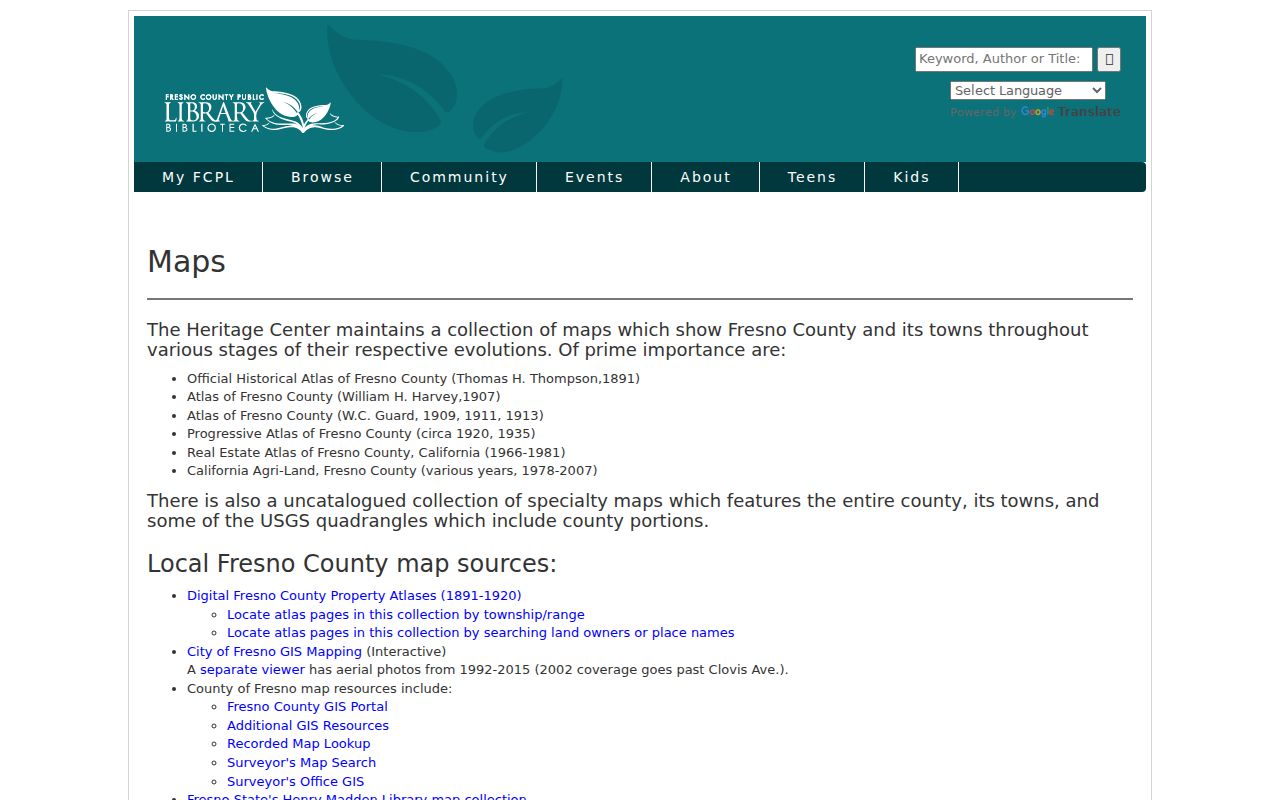
Atlas and Sanborn context can expose a changed subdivision or old street relationship that a text-only volume hides.
Open the library's Historic Homes research guide before using the residence-history image.
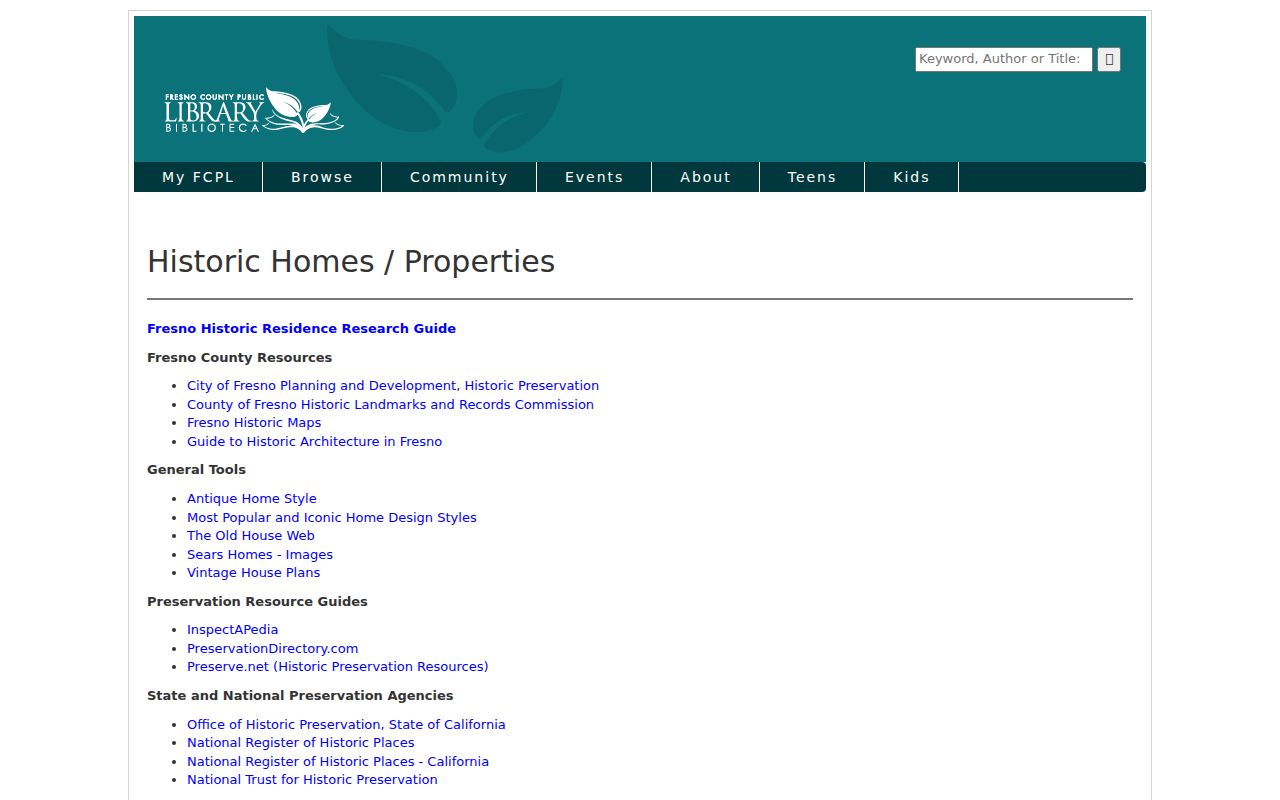
The historic-homes route is especially useful when a directory name needs a parcel, building, or preservation clue before it can be matched to a modern record.
Fresno County Birth and Obituary Indexes
The library holds California birth-index material for 1905-1995, death-index ranges from 1905 through the later 1990s, county marriage indexes for 1850-1952, California marriage ranges, divorce indexes, and Fresno Bee obituary coverage from 1962 to the present at the center. Remote obituary access is reported from 1985 through a card route. These sources can distinguish two people with the same surname and explain why a directory entry stops.
An index provides an event clue, not always a certified copy. For current or identity-valid copies, use Fresno Public Health, the Recorder, the County Clerk, or CDPH according to the event and date. A library finding should be carried into the custodian's process with the full name, place, event date, and relationship details.
See the library's birth, marriage, and death indexes before ordering a record.
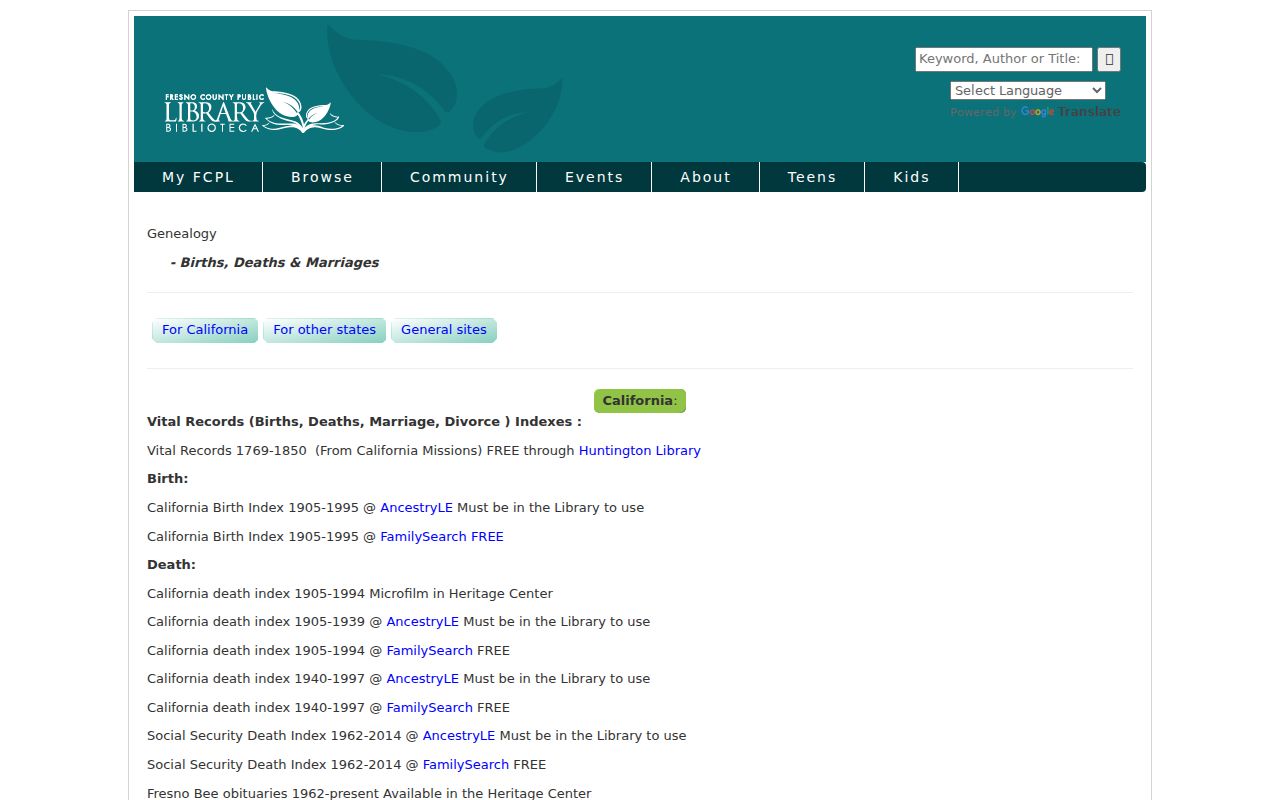
Index dates and directory dates work together: one places a person in a year, the other can supply the address or household context.
Fresno County Directory Timeline
The Fresno County publication story is a sequence of footprints. A timeline keeps a search from crossing a boundary without noticing. Use it as a routing aid, then verify the exact volume and page at the library.
| 1907 | Polk-Husted begins the familiar Fresno directory run. |
|---|---|
| 1909 | First Fresno County telephone directory appears with a broad regional footprint. |
| 1946 | Fresno City receives its own telephone book while rural areas remain in the regional series. |
| 1957 | Polk coverage becomes Fresno city only after the earlier countywide era. |
| 1964 | Clovis joins the Fresno telephone book. |
| 1973 | Haines Criss-Cross resumes countywide address coverage and Clovis returns to the Polk geography. |
| 1984 | Rural telephone coverage narrows again to Fresno and Madera. |
These dates explain why a directory hit is meaningful only when its publisher and footprint are named. For current parcel and deed work, use the modern address-keyed path instead of trying to stretch a historical volume beyond its scope. Current population context belongs with the Census QuickFacts Fresno County profile, whose estimates should be read with their year label.